
Grass & forage · 5 min read
Arable silage, Combicrop® or cereal wholecrop?
Three ways to grow your own spring-sown forage, and how they compare.

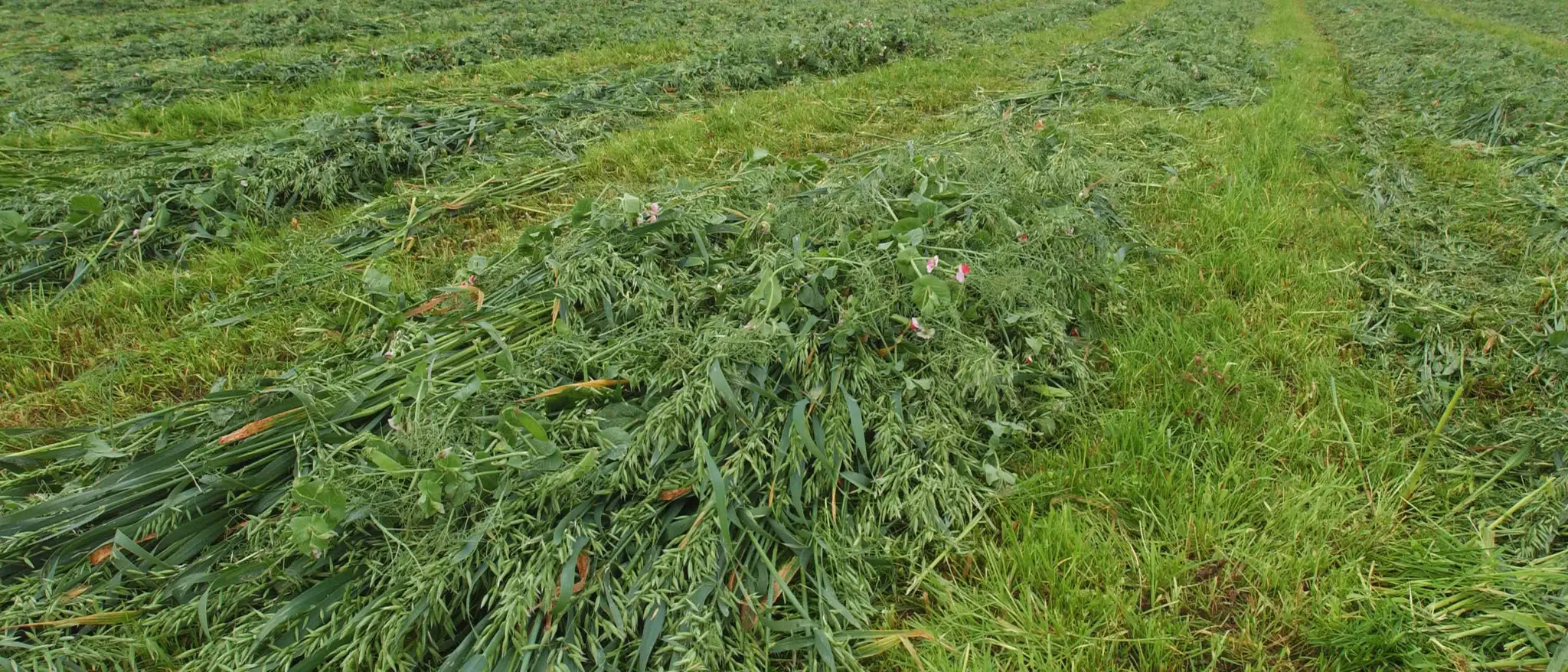
Three ways to grow your own forage
If you want to grow your own spring-sown forage and buy in less, our ranges give you three routes: an arable silage mix, Combicrop® taken as wholecrop, or a spring cereal wholecrop blend. Two of them grow a cereal with a legume for extra protein; the third is cereal only. They're sown at different rates, cut at very different stages and leave the field in a different state. Here they are side by side, so you can pick the one that fits your rotation.
Arable silage: a quick cut over a new ley
Our arable silage mixes are a blend of spring cereals with spring forage peas: REWARD and Organic DUET are barley and pea mixtures, LIBERTY and Organic TRIUMPH are oat and pea mixtures. The PLUS versions add vetch, which makes them particularly suitable if you suffer with pigeons or crows.
Arable silage fits well in to your cropping rotation after brassicas.
Arable silage is NOT a traditional wholecrop, and that's a common misunderstanding. It's designed specifically to use when sowing a new ley in spring and allows your fields to be productive sooner. It is ready to cut in just 9 to 10 weeks, at about 35% dry matter, so there's no grain in the crop. That gives you:
- Silage in the year you reseed. Around six 600 kg big bales per acre, making up for the grass you lose when you sow a ley in spring.
- Palatable, high-protein, high-sugar forage. The forage peas bulk up quickly, adding yield and protein.
- No grain in the bales or clamp, so they're less attractive to rats.
- Nitrogen for the ley. The peas fix nitrogen that gives the new ley a kick-start.
Combicrop®: grow your own concentrate
Combicrop® is our own blend of a spring cereals and combinable peas or beans, grown together as one crop. You can combine it dry, crimp it or cut it as wholecrop. As wholecrop you can either:
- ferment it at 25–45% dry matter, to feed on its own or with grass silage; or
- ferment and preserve it at 50–70% dry matter, to feed with other conserved forage. Ask your silage additive supplier which additive to use.
Combined dry, Combicrop® makes a 13–18% protein concentrate, typically 50–60% more protein than the cereal alone. As wholecrop the protein percentage is raised too; ask us what to expect from your mix.
Combicrop is available as conventional seed, or as organic seed. Seed rates run from 75 to 120 kg per acre, depending on the mix. Our complete guide to growing Combicrop® covers drilling, fertiliser and harvest in full.
Spring Cereal Blends: versatile and resiliant
If you'd rather grow just cereal, our spring sown cereal blends can be combined dry, crimped or wholecropped. see our guide to spring cereal blends.
Two of our blends are designed specifically for wholecrop. Organic MELODY is a blend of wheat, barley and oats; Organic CHIME is barley and oats. Each is supplied in the same constant ratio, so no one cereal dominates the crop.
Disease can badly hurt the forage quality of a wholecrop, and these blends are proven to considerably lessen leaf and root disease. Sow Organic MELODY at 100 kg per acre and Organic CHIME at 75–100 kg per acre.
Side by side
- Sowing: all three are spring-sown. Arable silage goes in as the cover crop when you sow a new ley. Combicrop® is drilled 2–4 cm deep into a seedbed prepared as for any cereal; it must be drilled, not broadcast.
- Seed rate: arable silage 50 kg per acre; Combicrop® 75–120 kg per acre, depending on the mix; Cereal blends 75 - 125 kg per acre, depending on mix.
- Cutting: arable silage at 9–10 weeks, at about 35% dry matter. Combicrop® wholecrop at 25–45% or 50–70% dry matter. A cereal wholecrop is usually cut 15–16 weeks after sowing, at the cheesy stage.
- Protein: the peas raise the protein in both arable silage and Combicrop®. Organic MELODY and Organic CHIME are cereal only, so they carry no legume protein.
- What's left behind: arable silage leaves a thick new ley. Combicrop® leaves nitrogen from the legume in the soil for the next crop and an improved soil structure.
Undersowing a ley
This is where the three differ most.
- Sowing a new ley in spring? Use arable silage. A wholecrop sits on the seedling grass for 15–16 weeks, and too much grass is lost for lack of light, leaving a thin, weedy ley that doesn't perform. Arable silage comes off at 9–10 weeks, leaving a thick, clean ley, and clover establishes better, especially red clover.
- Want grazing after harvest? Undersow a spring cereal blend or Combicrop® with PREMIUM, our 6-month grass cover crop, at 5 kg per acre. Its grasses won't grow up through the cereal, and it gives you worm-free, clean grazing from autumn until you plough in spring.
Which should you grow?
- Reseeding in spring and short of silage: an arable silage mix.
- After a high protein/starch feed, with the option to combine or crimp instead: Combicrop®.
- Want a cereal wholecrop with less disease: Use a mixture from our spring cereal range.
Not sure which fits? Ask us, and we'll help you match the crop to your farm.
Common questions.
No. Arable silage is designed as a cover crop to a new ley and is cut at 9 to 10 weeks, before there's grain in the crop. Wholecrop is cut at 15 to 16 weeks, which is too long to leave over a new ley.
They contain vetch as well as forage peas to make them particularly suitable if you suffer with pigeons or crows.
Yes. Combicrop® carries more protein than a straight cereal, so it needs the right additive for that. Ask your silage additive supplier.
Yes. Because it comes off at 9 to 10 weeks, the young ley gets the light it needs, and clover establishes much better, especially red clover.
Seed for this job
Related ranges.
Arable Silage
Not to be confused with wholecrop, our arable silage mixtures are developed for farmers needing a reliable way to establish a strong, healthy new ley in spring.
View rangeSpring Cereal Blends
Spring barley, oat and wheat blends — versatile crops giving high yields with minimal disease.
View rangeCombicrop®
Cereal and legume Combicrop® mixtures. The profitable and sustainable way to grow your own high-protein, high-starch concentrate.
View rangeKeep reading
More from the field.
Before you drill
Talk it through with an agronomist.
Tell us the field and what you want it to do. We'll help you settle the mix and the timing — and blend it if you'd like us to.
The Drill
Seasonal advice, in your inbox.
The Drill is our free newsletter delivered periodically to your inbox with seasonal advice and information. A few notes a season - no noise.